
person
Bathsheba
בַּת־שֶׁ֫בַע
- verses
- 12
- first named
- 2 Samuel 11:3
- last named
- Psalms 51:1
- period
- United Monarchy
- role
- David's wife
Description
Who was Bathsheba?
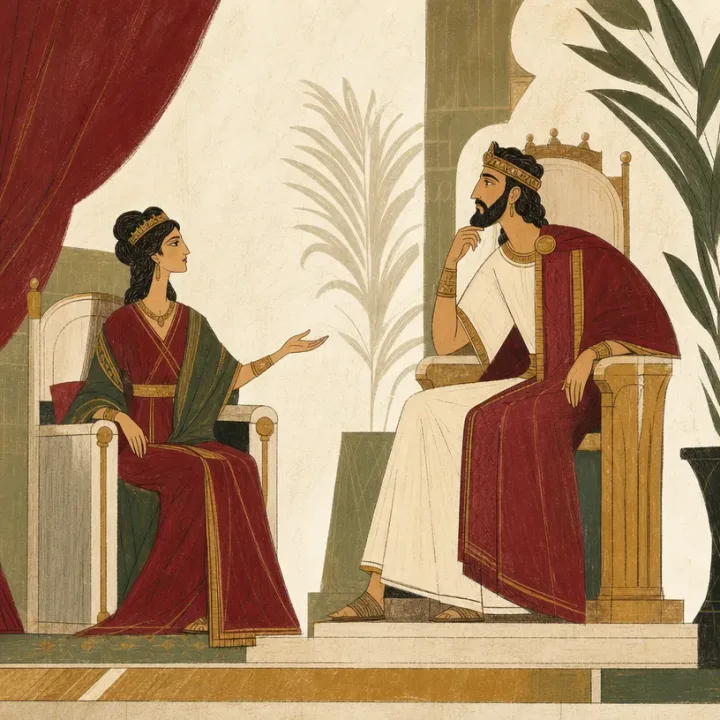
Bathsheba was the wife of Uriah the Hittite, one of David's mighty men. David committed adultery with her, resulting in her pregnancy (2Sa.11.3). After Uriah's death in battle, arranged by David, Bathsheba became David's wife and gave birth to Solomon (2Sa.12.24). Later, when David was old, Bathsheba and the prophet Nathan worked together to ensure Solomon's ascension to the throne (1Ki.1.11-31). As queen mother, Bathsheba held a position of influence in the royal court (1Ki.2.13-19). She is also mentioned in the superscription of Psalm 51, which is associated with David's repentance after his sin with Bathsheba. In 1Ch.3.5, Bathsheba is referred to as "Bath-shua," and her four sons with David are listed. Bathsheba's story illustrates the consequences of sin, God's mercy and forgiveness, and the importance of divine sovereignty in the fulfillment of God's plans.
Relations
Direct connections
Every entity the graph places in a stated relation with this one, grouped by the kind of link. Each relation is authored once and its inverse derived, so both ends always agree. Rows marked “registry” come from the identity spine rather than from a verse, and a row marked “which bearer is the source’s decision” is one where the name could have meant more than one person. The last group is not a relation at all — it counts the events two entities stand in together.
The 10 best-attested of 14 are drawn. All 14 are listed below.
Child of
Mother of
- Nathanregistry1 Chronicles 3:5
- Shammuaregistry1 Chronicles 3:5
- Shobabregistry1 Chronicles 3:5
- Solomonregistry1 Kings 2:131 Chronicles 3:5
Partner of
- Davidregistry2 Samuel 11:27
- Uriahregistry2 Samuel 11:3
Stands in the same events as
Places
Where this happens
The places the claims about this person reach, drawn where the gazetteer locates them. A point is where a row puts them and never where tradition does; no line joins two points, because the rows state where and not in what order.
The pattern
Where Bathsheba is named
Every book of the corpus in the order it is read, each as wide as the chapters it holds. A bar is the verses of that book which write the name, and the flat stretches are as much of the answer as the bars.
12 verses across 4 of 66 books; 62 write the name nowhere. Named in 2 Samuel (2), 1 Kings (8), 1 Chronicles (1) and Psalms (1).
Read it
Where to read it
Every verse of the text carried here that names this entity — 12, across 4 books.
Onward
Where this page goes
Not the direct relations above — these are one hop further out, ranked so that a rare shared connection outweighs a common one. Descriptions by STEPBible TIPNR.
Where they appear
Chapter by chapter
Atlas's reading of each chapter this person appears in, in canonical order. One line per chapter, and each leads to the whole of it.
- 2 Samuel 11Bathsheba came to David, sent word that she was pregnant, mourned Uriah, and bore David a son.
- 2 Samuel 12Bathsheba bore David a son named Solomon, whom David comforted after the child’s death.
- 1 Kings 1Bathsheba carries Nathan’s warning to David and reminds the king of his oath concerning Solomon.
- 1 Kings 2Bathsheba carried Adonijah’s request to Solomon, who received her with a throne at his right hand.
Sources