
9 others in the registry answer to the name Pharaoh. Every Pharaoh in the Bible
person
Pharaoh
פַּרְעֹהΦαραώ
- verses
- 70
- first named
- Genesis 37:36
- last named
- Acts 7:13
- period
- the Patriarchs
- tribe
- Egypt
Description
Who was Pharaoh?
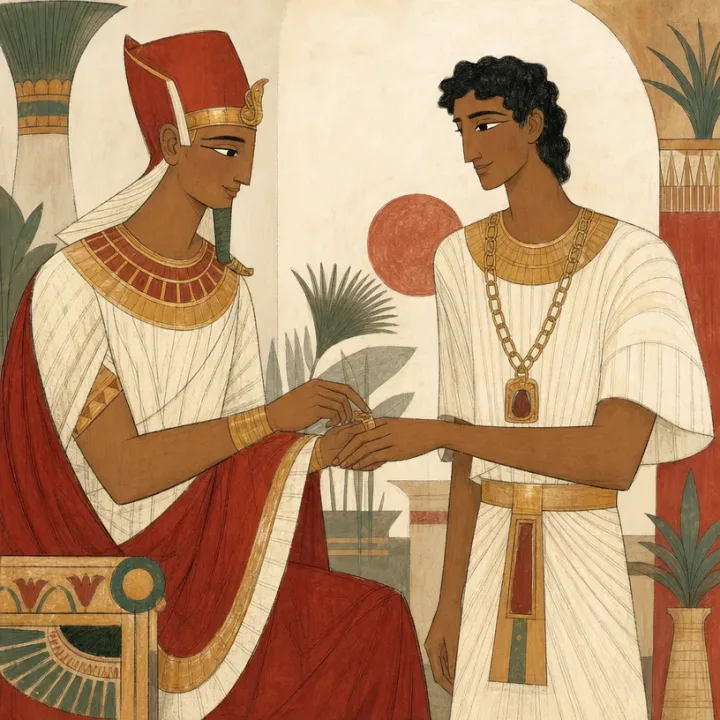
This Pharaoh was the Egyptian ruler during the time of Joseph, the son of Israel (or 'Jacob') (Genesis 37-50). Joseph was sold into slavery by his brothers and eventually served in the household of Potiphar, one of Pharaoh's officials. After being falsely accused and imprisoned, Joseph interpreted the dreams of Pharaoh's cupbearer and baker. When Pharaoh had troubling dreams, the cupbearer remembered Joseph's ability, and Joseph was brought before Pharaoh to interpret the dreams.
Joseph interpreted Pharaoh's dreams as a warning of seven years of plenty followed by seven years of severe famine. Impressed by Joseph's wisdom, Pharaoh appointed him as second-in-command over Egypt to prepare for the famine. During the famine, Joseph's brothers came to Egypt to buy grain, and after a series of tests, Joseph revealed his identity to them. Pharaoh invited Joseph's family to settle in the land of Goshen and provided for their needs.
This Pharaoh is depicted as a ruler who recognized and rewarded wisdom, and who showed kindness to Joseph and his family. The Bible does not provide the specific name or historical identity of this Pharaoh, as the term "Pharaoh" was used as a title for Egyptian kings. Some scholars suggest that this Pharaoh may have been from the Hyksos dynasty, a Semitic people who ruled Egypt during the Second Intermediate Period.
Relations
Direct connections
Every entity the graph places in a stated relation with this one, grouped by the kind of link. Each relation is authored once and its inverse derived, so both ends always agree. Rows marked “registry” come from the identity spine rather than from a verse, and a row marked “which bearer is the source’s decision” is one where the name could have meant more than one person. The last group is not a relation at all — it counts the events two entities stand in together.
The 10 best-attested of 11 are drawn. All 11 are listed below.
Places
Where this happens
The places the claims about this person reach, drawn where the gazetteer locates them. A point is where a row puts them and never where tradition does; no line joins two points, because the rows state where and not in what order.
The pattern
Where Pharaoh is named
Every book of the corpus in the order it is read, each as wide as the chapters it holds. A bar is the verses of that book which write the name, and the flat stretches are as much of the answer as the bars.
70 verses across 2 of 66 books; 64 write the name nowhere. Named in Genesis (68) and Acts (2).
Read it
Where to read it
Every verse of the text carried here that names this entity — 70, across 2 books. The name is written 90 times in them.
Genesis68 verses
37:3639:140:240:740:1140:1340:1440:1740:1940:2040:2141:141:441:741:841:941:1041:1441:1541:1641:1741:2541:2841:3241:3341:3441:3541:3741:3841:3941:4141:4241:4441:4541:4641:5542:1542:1644:1845:245:845:1645:1745:2146:546:3146:3347:147:247:347:447:547:747:847:947:1047:1147:1447:1947:2047:2247:2347:2447:2547:2650:450:650:7
Acts2 verses
Onward
Where this page goes
Nothing in the graph stands one hop from this entity yet. These are the best-connected entities of the same type, so the page still ends somewhere. Descriptions by STEPBible TIPNR.
Where they appear
Chapter by chapter
Atlas's reading of each chapter this person appears in, in canonical order. One line per chapter, and each leads to the whole of it.
- Genesis 40Pharaoh imprisoned two officers, held a birthday feast, restored the cupbearer, and hanged the baker.
- Genesis 41Pharaoh dreams twice, summons Egypt’s interpreters, listens to Joseph, and places him over the land.
- Genesis 45Pharaoh hears that Joseph’s brothers have come and offers them the best of Egypt, wagons, and a welcome back.
- Genesis 46Pharaoh is the ruler whose summons will ask the arriving household what occupation it practises.
- Genesis 47Pharaoh questioned Joseph’s brothers, granted Goshen, and supplied the priests with rations.
- Genesis 50Pharaoh allowed Joseph to go up and bury his father as he had sworn to do.
- Acts 7Pharaoh appointed Joseph ruler over Egypt and all his household.
Sources