
person
Abner
אֲבִינֵר
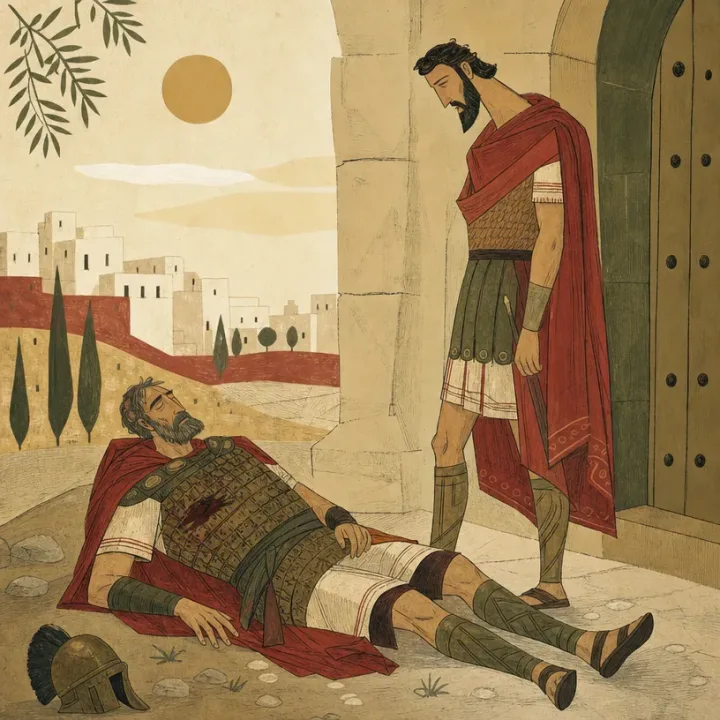
Abner, the son of Ner, was King Saul's cousin and the commander of his army; he later supported Saul's son Ish-bosheth as king before defecting to David.
- verses
- 53
- first named
- 1 Samuel 14:50
- last named
- 1 Chronicles 27:21
- period
- United Monarchy
- tribe
- Benjamin
Description
Who was Abner?
Abner was the son of Ner and the cousin of King Saul, Israel's first monarch. He served as the commander of Saul's army (1Sa.14.50-51). Abner was a prominent figure during Saul's reign and demonstrated his loyalty to the king, as seen in his interactions with David (1Sa.17.55-57; 20.25; 26.5-15).
After Saul's death, Abner supported Saul's son Ish-bosheth as king over Israel, while David reigned over Judah (2Sa.2.8-10). During this time, there was a long war between the houses of Saul and David (2Sa.3.1). Abner led Ish-bosheth's forces against David's army, commanded by Joab (2Sa.2.12-17). In a battle at Gibeon, Abner killed Joab's brother Asahel, who had pursued him (2Sa.2.18-23).
Later, Abner defected to David after a dispute with Ish-bosheth (2Sa.3.6-21). He worked to transfer the kingdom to David and made an agreement with him (2Sa.3.12-21). However, Joab, seeking revenge for his brother's death, murdered Abner (2Sa.3.22-27). David mourned Abner's death and declared his innocence in the matter (2Sa.3.28-39).
Abner's defection and death weakened Ish-bosheth's position, and he was eventually assassinated (2Sa.4.1-8). This paved the way for David to become king over all Israel (2Sa.5.1-5). David later reminded Solomon of Joab's actions against Abner (1Ki.2.5, 32). Abner is also mentioned in connection with the treasures dedicated to the Lord (1Ch.26.28) and as the father of Jaasiel, a leader in David's army (1Ch.27.21).
Relations
Direct connections
Every entity the graph places in a stated relation with this one, grouped by the kind of link. Each relation is authored once and its inverse derived, so both ends always agree. Rows marked “registry” come from the identity spine rather than from a verse, and a row marked “which bearer is the source’s decision” is one where the name could have meant more than one person. The last group is not a relation at all — it counts the events two entities stand in together.
The 10 best-attested of 14 are drawn. All 14 are listed below.
Child of
- Nerregistry1 Samuel 14:511 Kings 2:321 Samuel 14:50 +8
Father of
- Jaasielregistry1 Chronicles 27:21
Stands in the same events as
- David21 events
- Joab10 events
- Saul5 events
- Hebron4 events
- Asahel4 events
- Ish-bosheth4 events
- Israel3 events
- Mahanaim3 events
- Abishai2 events
- Sword1 event
- Gathering1 event
- Jordan1 event
and 14 more, ordered by how many events they share.
Places
Where this happens
The places the claims about this person reach, drawn where the gazetteer locates them. A point is where a row puts them and never where tradition does; no line joins two points, because the rows state where and not in what order.
The pattern
Where Abner is named
Every book of the corpus in the order it is read, each as wide as the chapters it holds. A bar is the verses of that book which write the name, and the flat stretches are as much of the answer as the bars.
53 verses across 4 of 66 books; 62 write the name nowhere. Named in 1 Samuel (9), 2 Samuel (40), 1 Kings (2) and 1 Chronicles (2).
Read it
Where to read it
Every verse of the text carried here that names this entity — 53, across 4 books. The name is written 63 times in them.
Onward
Where this page goes
Not the direct relations above — these are one hop further out, ranked so that a rare shared connection outweighs a common one. Descriptions by STEPBible TIPNR.
Where they appear
Chapter by chapter
Atlas's reading of each chapter this person appears in, in canonical order. One line per chapter, and each leads to the whole of it.
- 1 Samuel 17Abner commands the army, admits he does not know David’s father, and brings David before Saul.
- 1 Samuel 20Abner sat beside Saul at the royal meal while David’s place stood empty.
- 1 Samuel 26Abner guarded the sleeping king so successfully that David later had to shout across the distance to wake his reputation.
- 2 Samuel 2Abner takes Ish-bosheth to Mahanaim, makes him king, leads his men to Gibeon, and finally calls for the pursuit to stop.
- 2 Samuel 3Abner strengthens Saul’s house, quarrels with Ish-bosheth, offers David the kingdom, and is killed at Hebron by Joab.
- 2 Samuel 4Abner’s death leaves Ish-bosheth without courage, and his tomb receives Ish-bosheth’s head.
Sources