
2 others in the registry answer to the name Hebron. Every Hebron in the Bible
place · also Kiriath-arba
Hebron
חֶבְרוֹן
- verses
- 57
- first named
- Genesis 13:18
- last named
- Nehemiah 11:25
- feature
- settlement
- coordinates
- 31.53°N · 35.10°E
Tel Rumeida (OpenBible)
The gazetteer records one identification, and no competing one.
Description
Hebron in the text
Hebron, also known as Kiriath-arba, was an important city located in the hill country of Judah. It is first mentioned in Genesis 13:18, where Abraham pitched his tent and built an altar to the Lord. It was possibly renamed Hebron by Mareshah the "father [<i>abi</i>] of Hebron", which narmally refers to a founder, though he also had a son named Hebron (1Ch.2.42-43). The city was originally named Kiriath-arba, which means "the city of Arba," who was the greatest man among the Anakim (Joshua 14:15).
Hebron played a significant role in the lives of the patriarchs. Sarah, Abraham's wife, died in Kiriath-arba, and Abraham purchased the cave of Machpelah as a burial site for her (Genesis 23:2, 19). Later, Abraham, Isaac, and Israel (or 'Jacob') were also buried there (Genesis 35:27; 49:29-32).
During the conquest of Canaan, Hebron was taken by Joshua and the Israelites (Joshua 10:36-37). The city was given to Caleb as his inheritance (Joshua 14:13-14), and later became a city of the Levites and a city of refuge (Joshua 20:7; 21:11-13).
Hebron served as the capital of Judah during the reign of David. He was anointed king over the house of Judah in Hebron and reigned there for seven and a half years (2Sa.2.1-4, 11; 5:5). Several of David's sons were born in Hebron, including Amnon, Absalom, and Adonijah (2Sa.3.2-5).
The city remained significant throughout Israel's history. It was fortified by Rehoboam (2Ch.11.10) and was inhabited by Jews after the Babylonian exile (Nehemiah 11:25).
Hebron is also notable for its association with the Anakim, a group of giants who inhabited the area (Numbers 13:22, 33). Caleb drove out the three sons of Anak from Hebron: Sheshai, Ahiman, and Talmai (Joshua 15:13-14; Judges 1:10, 20).
Today, Hebron is still an important city, known for the Tomb of the Patriarchs, which is believed to be the burial site of Abraham, Isaac, and Jacob. The city has a rich history and holds great significance for Jews, Christians, and Muslims alike.
Relations
Direct connections
Every entity the graph places in a stated relation with this one, grouped by the kind of link. Each relation is authored once and its inverse derived, so both ends always agree. Rows marked “registry” come from the identity spine rather than from a verse, and a row marked “which bearer is the source’s decision” is one where the name could have meant more than one person. The last group is not a relation at all — it counts the events two entities stand in together.
The pattern
Where Hebron is named
Every book of the corpus in the order it is read, each as wide as the chapters it holds. A bar is the verses of that book which write the name, and the flat stretches are as much of the answer as the bars.
57 verses across 10 of 66 books; 56 write the name nowhere. Named in Genesis (4), Numbers (1), Joshua (15), Judges (3), 1 Samuel (1), 2 Samuel (21), 1 Kings (1), 1 Chronicles (9), 2 Chronicles (1) and Nehemiah (1).
Read it
Where to read it
Every verse of the text carried here that names this entity — 57, across 10 books. The name is written 70 times in them.
Genesis4 verses
Numbers1 verse
Joshua15 verses
10:310:510:2310:3610:3911:2112:1014:1314:1414:1515:1315:5420:721:1121:13
Judges3 verses
1 Samuel1 verse
2 Samuel21 verses
2:12:32:112:323:23:53:193:203:223:273:324:14:84:125:15:35:55:1315:715:915:10
1 Kings1 verse
1 Chronicles9 verses
2 Chronicles1 verse
Nehemiah1 verse
Onward
Where this page goes
Nothing in the graph stands one hop from this entity yet. These are the best-connected entities of the same type, so the page still ends somewhere. Descriptions by STEPBible TIPNR.
Where they appear
What happened here
Atlas's reading of each chapter this place appears in, in canonical order. One line per chapter, and each leads to the whole of it.
- Genesis 23Hebron, called Kiriath-arba, was where Sarah died and near where she was buried.
- Numbers 13Hebron is visited by the spies, who find Ahiman, Sheshai, and Talmai there.
- Joshua 15Hebron was given to Caleb as his portion among the sons of Judah.
- Joshua 21Hebron was given with its surrounding pasturelands as a city of refuge for the manslayer.
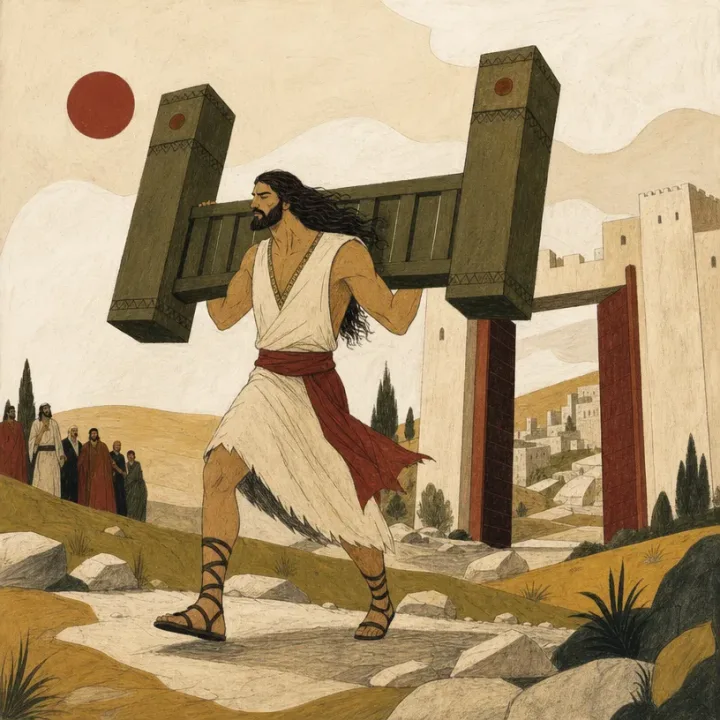
- Judges 16The mountain overlooking Hebron received the city gate and its posts on Samson’s shoulders.
- 2 Samuel 2Hebron receives David, his household, and his first royal anointing in this chapter.
- 2 Samuel 3Hebron is where David’s sons are born, where Abner feasts with David, and where Abner is buried after Joab kills him.
- 2 Samuel 5Hebron is where David is made king and reigns over Judah for seven years and six months.
Sources