
person · also Pontius
Pilate
Πιλᾶτος
- verses
- 53
- first named
- Matthew 27:2
- last named
- 1 Timothy 6:13
- period
- the New Testament
- role
- Ruler
Description
Who was Pilate?
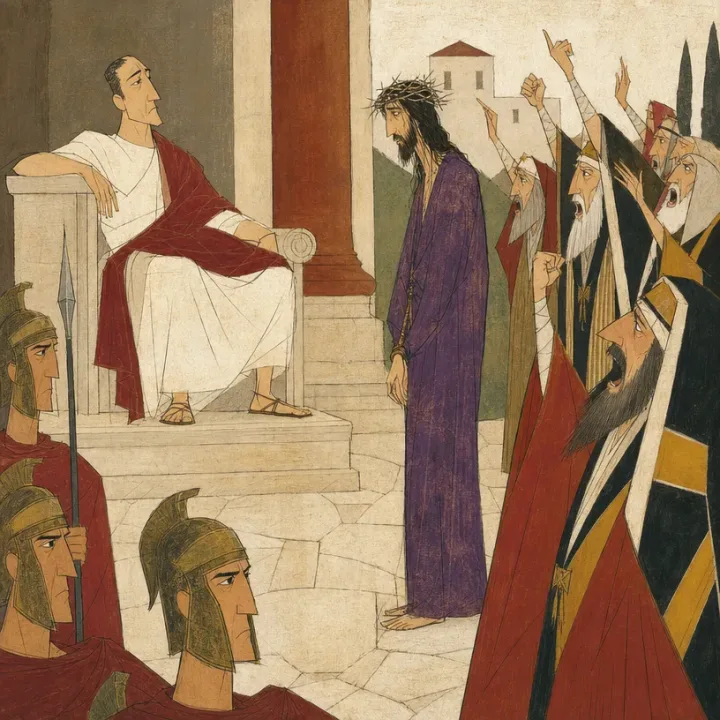
Pontius Pilate was the Roman governor (prefect) of Judea during the time of Jesus' ministry and crucifixion (Luk.3.1). He is most known for his role in the trial and execution of Jesus, as recorded in all four Gospels (Matthew 27; Mark 15; Luke 23; John 18-19).
When Jesus was brought before Pilate by the Jewish leaders, who accused him of claiming to be the king of the Jews, Pilate questioned Jesus and found no fault in him (Jhn.18.29-38). However, faced with the insistence of the Jewish leaders and the growing crowd, Pilate ultimately gave in to their demands and ordered Jesus to be crucified (Mat.27.24; Mrk.15.15; Luk.23.24; Jhn.19.16).
Pilate is portrayed as a reluctant participant in Jesus' death, attempting to release him but ultimately succumbing to political pressure (Jhn.19.12). He is also depicted as a somewhat cynical and world-weary figure, as seen in his famous question to Jesus, "What is truth?" (Jhn.18.38).
Pilate's involvement in Jesus' crucifixion is also mentioned in the Book of Acts, where the early Christian leaders affirm that Jesus was crucified under Pontius Pilate (Act.3.13; 4.27; 13.28). In 1Ti.6.13, Paul refers to Jesus' good confession before Pontius Pilate.
Relations
Direct connections
Every entity the graph places in a stated relation with this one, grouped by the kind of link. Each relation is authored once and its inverse derived, so both ends always agree. Rows marked “registry” come from the identity spine rather than from a verse, and a row marked “which bearer is the source’s decision” is one where the name could have meant more than one person. The last group is not a relation at all — it counts the events two entities stand in together.
The 10 best-attested of 11 are drawn. All 11 are listed below.
Stands in the same events as
- Jesus38 events
- Judah7 events
- Joseph6 events
- Herod5 events
- Israel3 events
- Prisoner3 events
- Feast2 events
- Crucifixion2 events
- Barabbas2 events
- Crowd2 events
- They, Your Own People, and Chief Priests’ handing over2 events
- Sacrifice1 event
and 10 more, ordered by how many events they share.
Places
Where this happens
The places the claims about this person reach, drawn where the gazetteer locates them. A point is where a row puts them and never where tradition does; no line joins two points, because the rows state where and not in what order.
The pattern
Where Pilate is named
Every book of the corpus in the order it is read, each as wide as the chapters it holds. A bar is the verses of that book which write the name, and the flat stretches are as much of the answer as the bars.
53 verses across 6 of 66 books; 60 write the name nowhere. Named in Matthew (8), Mark (10), Luke (12), John (19), Acts (3) and 1 Timothy (1).
Read it
Where to read it
Every verse of the text carried here that names this entity — 53, across 6 books. The name is written 59 times in them.
Onward
Where this page goes
Nothing in the graph stands one hop from this entity yet. These are the best-connected entities of the same type, so the page still ends somewhere. Descriptions by STEPBible TIPNR.
Where they appear
Chapter by chapter
Atlas's reading of each chapter this person appears in, in canonical order. One line per chapter, and each leads to the whole of it.
- Matthew 27Pilate questioned Jesus, offered the crowd a choice, released Barabbas, and handed Jesus over to be crucified.
- Mark 15Pilate questioned Jesus, offered the crowd its choice, released Barabbas, and granted Jesus’ body to Joseph after confirming His death.
- Luke 13Pilate has the blood of Galileans mixed with their sacrifices.
- Luke 23Pilate repeatedly found no capital charge against Jesus, yet sentenced Him when the crowd’s demand prevailed.
- John 18Pilate questioned Jesus, found no basis for a charge, and offered the crowd a choice between Jesus and Barabbas.
- John 19Pilate repeatedly declares that he finds no basis for a charge against Jesus, posts the notice naming Him king of the Jews, and finally hands Him over to be crucified.
- Acts 3Pilate had decided to release Jesus before the people handed Him over.
- 1 Timothy 6Pilate was the one before whom Jesus made his good confession.
Sources