
person · also Saul
Paul
Παῦλος
Paul, also known as Saul, the apostle to the Gentiles and author of many New Testament epistles.
- verses
- 182
- first named
- Acts 7:58
- last named
- 2 Peter 3:16
- period
- the New Testament
- role
- Apostle
Description
Who was Paul?
Paul, also known as Saul, was one of the most influential figures in early Christianity. He was born in Tarsus as a Roman citizen and trained as a Pharisee under Gamaliel. Initially a persecutor of the church, Paul had a dramatic conversion experience on the road to Damascus, where the risen Jesus appeared to him. After this, he became a zealous preacher of the gospel, undertaking several missionary journeys throughout the Mediterranean world. Paul played a key role in spreading Christianity among the Gentiles and in articulating its theological foundations. He wrote many of the epistles in the New Testament, providing guidance and instruction to the early churches. Paul faced numerous challenges, including opposition from Jewish leaders, internal disputes among believers, and physical hardships. He was eventually arrested and taken to Rome, where tradition holds that he was martyred during the reign of Nero. Paul's life and teachings had a profound impact on the development of Christian thought and practice.
Relations
Direct connections
Every entity the graph places in a stated relation with this one, grouped by the kind of link. Each relation is authored once and its inverse derived, so both ends always agree. Rows marked “registry” come from the identity spine rather than from a verse, and a row marked “which bearer is the source’s decision” is one where the name could have meant more than one person. The last group is not a relation at all — it counts the events two entities stand in together.
The 10 best-attested of 18 are drawn. All 18 are listed below.
Places
Where this happens
The places the claims about this person reach, drawn where the gazetteer locates them. A point is where a row puts them and never where tradition does; no line joins two points, because the rows state where and not in what order.
The pattern
Where Paul is named
Every book of the corpus in the order it is read, each as wide as the chapters it holds. A bar is the verses of that book which write the name, and the flat stretches are as much of the answer as the bars.
182 verses across 15 of 66 books; 51 write the name nowhere. Named in Acts (152), Romans (1), 1 Corinthians (7), 2 Corinthians (2), Galatians (2), Ephesians (2), Philippians (1), Colossians (3), 1 Thessalonians (2), 2 Thessalonians (2), 1 Timothy (1), 2 Timothy (2), Titus (1), Philemon (3) and 2 Peter (1).
Read it
Where to read it
Every verse of the text carried here that names this entity — 182, across 15 books. The name is written 190 times in them.
Acts152 verses
7:588:18:39:19:49:89:119:179:199:229:249:2611:2511:3012:2513:113:213:713:913:1313:1613:4313:4513:4613:5014:914:1114:1214:1414:1915:215:1215:2215:2515:3515:3615:3815:4016:316:916:1416:1716:1816:1916:2516:2816:2916:3616:3717:217:417:1017:1317:1417:1517:1617:2217:3318:118:518:918:1218:1418:1819:119:419:619:1119:1319:1519:2119:2619:2919:3020:120:720:920:1020:1320:1620:3721:421:821:1121:1321:1821:2621:2921:3021:3221:3721:3921:4022:722:1322:2522:2822:3023:123:323:523:623:1023:1123:1223:1423:1623:1723:1823:2023:2423:3123:3324:124:1024:2324:2424:2624:2725:225:425:625:725:825:925:1025:1425:1925:2125:2326:126:1426:2426:2526:2826:2927:127:327:927:1127:2127:2427:3127:3327:4328:328:828:1528:1628:1728:2528:30
Romans1 verse
1 Corinthians7 verses
2 Corinthians2 verses
Galatians2 verses
Ephesians2 verses
Philippians1 verse
Colossians3 verses
1 Thessalonians2 verses
2 Thessalonians2 verses
1 Timothy1 verse
2 Timothy2 verses
Titus1 verse
Philemon3 verses
2 Peter1 verse
Onward
Where this page goes
Not the direct relations above — these are one hop further out, ranked so that a rare shared connection outweighs a common one. Descriptions by STEPBible TIPNR.
Where they appear
Chapter by chapter
Atlas's reading of each chapter this person appears in, in canonical order. One line per chapter, and each leads to the whole of it.
- Acts 9Paul pursued the disciples to Damascus, then proclaimed Jesus, escaped that city in a basket, and spoke boldly in Jerusalem.
- Acts 11Saul was brought from Tarsus by Barnabas and taught the church in Antioch for a full year.
- Acts 12Saul returned from Jerusalem with Barnabas, bringing John, also called Mark.
- Acts 13Paul proclaimed the word in synagogues, preached Jesus at Pisidian Antioch, and turned to the Gentiles when opposition closed in.
- Acts 14Paul preached boldly, healed a man in Lystra, resisted being called Hermes, endured stoning, and returned to the city before continuing the journey.
- Acts 15Paul debated the men from Judea, reported God’s work among the Gentiles, and later travelled with Silas after parting from Barnabas.
- Acts 16Paul takes Timothy along, speaks by the river, commands a spirit to leave a slave girl, sings in prison, and insists that the magistrates come out themselves.
- Acts 17Paul reasoned in synagogues and marketplaces, proclaimed Jesus and the resurrection, and addressed the Areopagus.
34 more chapters, from Acts 18 to 2 Peter 3
- Acts 18Paul left Athens for Corinth, worked as a tentmaker, reasoned in synagogues, endured opposition, and travelled on through Syria, Ephesus, Antioch, Galatia, and Phrygia.
- Acts 19Paul taught boldly in Ephesus, moved his discussions from the synagogue to the lecture hall of Tyrannus, and later planned the journey to Jerusalem, Macedonia, Achaia, and Rome.
- Acts 20Paul encouraged the disciples, travelled through Macedonia and Greece, spoke through the night, revived Eutychus, and gave the Ephesian elders a tearful farewell.
- Acts 21Paul travelled to Jerusalem despite repeated warnings, joined four men under a vow, was seized in the temple, and gained permission to speak to the crowd.
- Acts 22Paul gives his defense, recounts the light and the voices on the road to Damascus, and stops a flogging by declaring himself a Roman citizen.
- Acts 23Paul defended his conscience, exposed the division between Pharisees and Sadducees, survived a plot, and was carried under guard toward Caesarea.
- Acts 24Paul defended himself before Felix, speaking of the Way, resurrection, conscience, and the coming judgment.
- Acts 25Paul denies offending the law, the temple, or Caesar, and appeals to Caesar rather than be handed over to the accusers.
- Acts 26Paul defended himself before Agrippa, recounted the light on the road to Damascus, and wished that all who heard him might become what he was, chains excepted.
- Acts 27Paul warned against sailing on, later reported the angel’s promise, kept the company from abandoning ship, and urged them to eat.
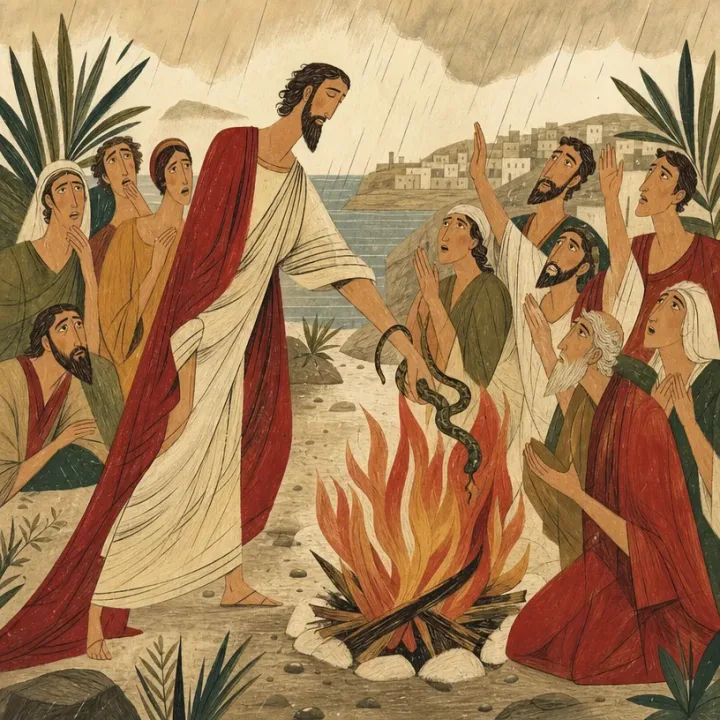
- Acts 28Paul survived a viper’s bite, healed the sick on Malta, travelled to Rome, and proclaimed the kingdom of God from his rented house.
- Romans 1Paul presents himself as Christ’s servant and apostle, prays for those in Rome, and plans a visit intended to strengthen both sides.
- 1 Corinthians 1Paul writes to Corinth, urges agreement, names the quarrels, remembers whom he baptized, and preaches Christ crucified.
- 1 Corinthians 3Paul planted the seed, laid the foundation as an expert builder, and served through whom the brothers believed.
- 1 Corinthians 4Paul describes himself as a servant of Christ, a steward, a father through the gospel, and an apostle ready to arrive with either a rod or a gentle spirit.
- 1 Corinthians 16Paul directs the collection, plans his journey, urges care for the workers, writes the final greeting in his own hand, and sends his love.
- 2 Corinthians 1Paul introduces himself as an apostle, writes of overwhelming hardship, asks for prayer, and explains why he did not return to Corinth.
- 2 Corinthians 10Paul appealed in Christ's gentleness, defended his authority, and planned to carry the gospel beyond the field already assigned to him.
- Galatians 1Paul defended the divine source of his gospel, recounted his former persecution, and described his journey from Arabia and Damascus to Jerusalem, Syria, and Cilicia.
- Galatians 5Paul argues for freedom, warns against the flesh, lists the Spirit’s fruit, and wishes an exceedingly drastic conclusion upon those agitating the Galatians.
- Ephesians 1Paul introduced himself as an apostle of Christ Jesus, greeted the saints in Ephesus, gave thanks for their faith and love, and prayed for them.
- Ephesians 3Paul served the gospel, preached the unsearchable riches of Christ, and prayed for strength and love while suffering for the Gentiles.
- Philippians 1Paul writes to Philippi with thanks, longing, boldness, and an unusually cheerful acceptance that even hostile preaching may advance Christ.
- Colossians 1Paul gives thanks, prays for the Colossians, serves the church by commission, and labors to proclaim the revealed mystery.
- 1 Thessalonians 1Paul addresses the Thessalonians with Silvanus and Timothy, remembers their faith, love, and hope, and recalls how the gospel was lived among them.
- 1 Thessalonians 2Paul tried again and again to return to the Thessalonians, but says that Satan obstructed him.
- 2 Thessalonians 1Paul joined Silvanus and Timothy in addressing the Thessalonian church, giving thanks for its growing faith and love, boasting of its endurance, and praying for its calling.
- 2 Thessalonians 3Paul asks for prayer, gives commands about work and discipline, offers his own conduct as an example, and signs the greeting in his own hand.
- 1 Timothy 1Paul writes as an apostle, recalls his former violence, entrusts Timothy with a command, and says he has handed over Hymenaeus and Alexander to Satan.
- 2 Timothy 1Paul writes to Timothy, remembers him in prayer, and speaks of his own suffering, chains, calling, and guarded trust.
- 2 Timothy 4Paul urges Timothy to proclaim the word, describes his departure as near, and asks him to come quickly with a cloak and scrolls.
- Titus 1Paul writes to Titus, explains why he left him in Crete, and directs him to appoint elders and rebuke those who contradict the faithful word.
- Philemon 1Paul wrote from chains, appealed for Onesimus, offered to repay any debt, and confidently expected more than he asked.
- 2 Peter 3Paul wrote about the Lord’s patience with the wisdom God gave him, though some parts of his letters are hard to understand.
Sources