
person · also Sarai
Sarah
שָׂרָהΣάρρα
- verses
- 48
- first named
- Genesis 11:29
- last named
- 1 Peter 3:6
- period
- the Patriarchs
- tribe
- Early Patriarch
Description
Who was Sarah?
Sarah, initially named Sarai, was the wife of Abraham and the mother of Isaac. She was born in Ur of the Chaldeans and married Abraham (then known as Abram) while they lived in Haran (Gen.11.29-31). Sarah accompanied Abraham when God called him to leave Haran and go to the land of Canaan (Gen.12.5). Despite God's promise that Abraham would have numerous descendants, Sarah was barren (Gen.11.30). In her impatience, she gave her Egyptian maidservant, Hagar, to Abraham as a wife to bear a child on her behalf (Gen.16.1-4). This resulted in the birth of Ishmael (Gen.16.15-16). When Abraham was 99 years old, God reaffirmed His covenant with him, changed his name from Abram to Abraham, and changed Sarai's name to Sarah (Gen.17.5, 15). God promised that Sarah would bear a son, Isaac, through whom the covenant would be established (Gen.17.19, 21; 18.10-14). Sarah initially laughed at this idea due to her advanced age (Gen.18.12-15). However, as God had promised, Sarah conceived and gave birth to Isaac when she was 90 years old (Gen.21.1-7). Sarah's faith is commended in Heb.11.11, which states that she received the ability to conceive because she considered God faithful to His promise. Sarah died at the age of 127 in Kirjath-arba (Hebron), and Abraham purchased the cave of Machpelah as a burial site for her (Gen.23.1-20). Her life story demonstrates the importance of faith, patience, and trust in God's promises, even in the face of seemingly impossible circumstances.
Relations
Direct connections
Every entity the graph places in a stated relation with this one, grouped by the kind of link. Each relation is authored once and its inverse derived, so both ends always agree. Rows marked “registry” come from the identity spine rather than from a verse, and a row marked “which bearer is the source’s decision” is one where the name could have meant more than one person. The last group is not a relation at all — it counts the events two entities stand in together.
The 10 best-attested of 14 are drawn. All 14 are listed below.
Child of
- Terahregistry, no verse
Mother of
- IsaacregistryGenesis 24:67
Partner of
- AbrahamregistryGenesis 11:29Genesis 11:31Genesis 12:11 +14
Sibling of
- AbrahamregistryGenesis 20:5
- Haranregistry, no verse
- Nahorregistry, no verse
Stands in the same events as
- Abraham30 events
- Abimelech7 events
- Hagar7 events
- Lot5 events
- Canaan4 events
- Pharaoh4 events
- Isaac3 events
- Terah3 events
- LORD2 events
- Sheep2 events
- Cattle2 events
- Haran2 events
and 18 more, ordered by how many events they share.
Places
Where this happens
The places the claims about this person reach, drawn where the gazetteer locates them. A point is where a row puts them and never where tradition does; no line joins two points, because the rows state where and not in what order.
The pattern
Where Sarah is named
Every book of the corpus in the order it is read, each as wide as the chapters it holds. A bar is the verses of that book which write the name, and the flat stretches are as much of the answer as the bars.
48 verses across 5 of 66 books; 61 write the name nowhere. Named in Genesis (43), Isaiah (1), Romans (2), Hebrews (1) and 1 Peter (1).
Read it
Where to read it
Every verse of the text carried here that names this entity — 48, across 5 books. The name is written 59 times in them.
Onward
Where this page goes
Not the direct relations above — these are one hop further out, ranked so that a rare shared connection outweighs a common one. Descriptions by STEPBible TIPNR.
Where they appear
Chapter by chapter
Atlas's reading of each chapter this person appears in, in canonical order. One line per chapter, and each leads to the whole of it.
- Genesis 12Sarai travelled with Abram, was presented as his sister in Egypt, and was taken into Pharaoh’s palace before being returned.
- Genesis 16Sarai gave Hagar to Abram, then blamed Abram and treated Hagar harshly when the arrangement turned bitter.
- Genesis 17Sarah was given a new name and promised a son who would be Isaac.
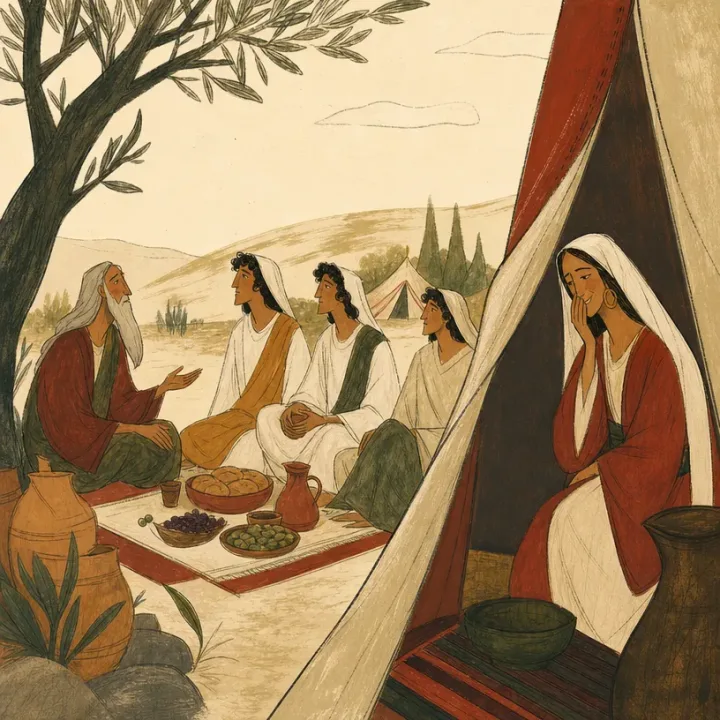
- Genesis 18Sarah prepared the bread, listened from the tent, laughed at the promise of a son, and then denied laughing.
- Genesis 20Sarah was taken to Abimelech, restored to Abraham, and named as the reason for the closed wombs in the household.
- Genesis 21Sarah bore Isaac, laughed at the astonishing turn of events, and demanded the expulsion of Hagar and Ishmael.
- Genesis 23Sarah lived 127 years and died in Kiriath-arba, that is, Hebron, in the land of Canaan.
- Isaiah 51Sarah gave birth to the one from whom the addressed people are told to look back.
2 more chapters, from Hebrews 11 to 1 Peter 3
Sources