
place · also Samaritan
Samaria
שֹׁמְרוֹןΣαμάρεια
Samaria was the capital city of the northern kingdom of Israel, and its inhabitants were known as Samaritans (1Ki. 16:24; 2Ki. 17:24; Jhn. 4:9; Act.8.5).
- verses
- 124
- first named
- 1 Kings 13:32
- last named
- Acts 15:3
- feature
- region
- coordinates
- 32.28°N · 35.20°E
Samaria (OpenBible)
The gazetteer records one identification, and no competing one.
Description
Samaria in the text
Samaria, the capital city of the northern kingdom of Israel, was built by King Omri around 880 BC (1Ki. 16:24). The city served as the royal residence and the center of political power for the northern kingdom until its fall to the Assyrians in 722 BC (2Ki. 17:5-6). After the Assyrian conquest, the region of Samaria was repopulated with people from various parts of the Assyrian Empire (2Ki. 17:24), who intermarried with the remaining Israelites and became known as Samaritans.
The Samaritans developed their own religious practices, which combined elements of Israelite tradition with foreign customs (2Ki. 17:26-28). They worshipped at Mount Gerizim instead of Jerusalem (Jhn. 4:20) and accepted only the first five books of the Bible as authoritative.
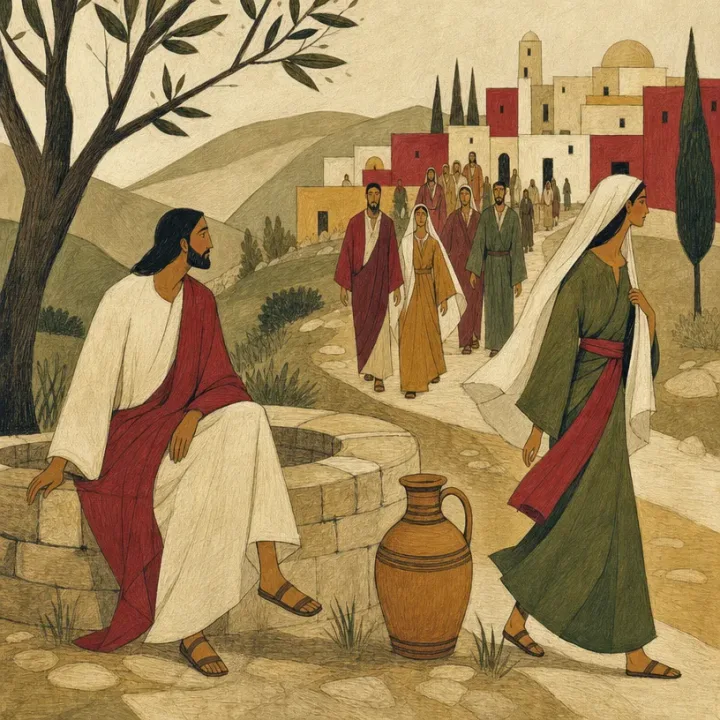
In the New Testament, Jesus encountered a Samaritan woman at Jacob's well (Jhn. 4:7-26) and used a Samaritan as an example of compassion in the parable of the Good Samaritan (Luk. 10:33). The early church spread to Samaria through the ministry of Philip (Act.8.5-25), and the apostles Peter and John later visited the region (Act.8.14-17).
Throughout the Bible, Samaria and the Samaritans are often portrayed as being in tension with the Jews due to religious and cultural differences (Jhn. 4:9; 8:48). However, Jesus and the early church demonstrated that the gospel was meant for all people, including the Samaritans.
Relations
Direct connections
Every entity the graph places in a stated relation with this one, grouped by the kind of link. Each relation is authored once and its inverse derived, so both ends always agree. Rows marked “registry” come from the identity spine rather than from a verse, and a row marked “which bearer is the source’s decision” is one where the name could have meant more than one person. The last group is not a relation at all — it counts the events two entities stand in together.
The pattern
Where Samaria is named
Every book of the corpus in the order it is read, each as wide as the chapters it holds. A bar is the verses of that book which write the name, and the flat stretches are as much of the answer as the bars.
124 verses across 16 of 66 books; 50 write the name nowhere. Named in 1 Kings (17), 2 Kings (45), 2 Chronicles (8), Ezra (2), Nehemiah (1), Isaiah (7), Jeremiah (3), Ezekiel (6), Hosea (6), Amos (5), Obadiah (1), Micah (3), Matthew (1), Luke (4), John (7) and Acts (8).
Read it
Where to read it
Every verse of the text carried here that names this entity — 124, across 16 books. The name is written 134 times in them.
1 Kings17 verses
13:3216:2416:2816:2916:3218:220:120:1020:1720:3420:4321:121:1822:1022:3722:3822:51
2 Kings45 verses
1:21:32:253:13:65:36:196:206:246:257:17:1810:110:1210:1710:3510:3613:113:613:913:1013:1314:1414:1614:2315:815:1315:1415:1715:2315:2515:2717:117:517:617:2417:2617:2817:2918:918:1018:3421:1323:1823:19
2 Chronicles8 verses
Ezra2 verses
Nehemiah1 verse
Isaiah7 verses
Jeremiah3 verses
Ezekiel6 verses
Hosea6 verses
Amos5 verses
Obadiah1 verse
Micah3 verses
Matthew1 verse
Luke4 verses
John7 verses
Acts8 verses
Onward
Where this page goes
Not the direct relations above — these are one hop further out, ranked so that a rare shared connection outweighs a common one. Descriptions by STEPBible TIPNR.
Where they appear
What happened here
Atlas's reading of each chapter this place appears in, in canonical order. One line per chapter, and each leads to the whole of it.
- 1 Kings 20Samaria was besieged, defended by a small force, and became the place to which Ahab returned in anger.
- 1 Kings 21Samaria was named as Ahab’s royal city when Elijah was sent to meet him.
- 2 Kings 1Samaria was where Ahaziah fell through the lattice of his upper room and lay injured.
- 2 Kings 2Elisha returned to Samaria after going to Mount Carmel.
- 2 Kings 6Samaria received the blinded Arameans for a feast and later endured a famine under siege.
- 2 Kings 10Samaria held Ahab’s seventy sons, received Jehu’s purge, and became the place of his burial and reign.
- 2 Chronicles 18Samaria hosted Ahab’s feast and the royal hearing at its gate.
- Isaiah 10Samaria is counted among the conquered kingdoms whose idols Assyria claims to have seized.
13 more chapters, from Jeremiah 23 to John 4
- Jeremiah 23Samaria was the place where prophets prophesied by Baal and led Israel astray.
- Jeremiah 31Samaria’s hills were planted with vineyards whose farmers would enjoy their fruit.
- Ezekiel 16Samaria is judged a less sinful sister of Jerusalem and is promised restoration with her daughters.
- Ezekiel 23Samaria was named as Oholah and supplied the cup Oholibah was made to drink.
- Hosea 7Samaria’s crimes are exposed alongside Ephraim’s iniquity.
- Hosea 8Samaria’s calf is rejected and marked for destruction.
- Hosea 10Samaria feared for its calf, mourned its removal, and was carried off with its king like a twig on water.
- Hosea 13Samaria bore her guilt after rebelling against her God, and its people fell by the sword.
- Amos 3Samaria was presented for inspection, surrounded by an enemy, and reduced to a ruinous remnant of household furniture.
- Amos 6Mount Samaria shelters those secure in their distinction and ease.
- Micah 1Samaria was named as Jacob’s transgression and condemned to become a heap of rubble.
- Luke 17Samaria lies beside Galilee as Jesus passes between them on the way to Jerusalem.
- John 4Samaria was crossed by Jesus, and its people came out believing after hearing the woman and Jesus.
Sources