
place · also Tyrian
Tyre
צֹרΤύριος
Tyre, a prominent Phoenician port city, known for its wealth, trade, and craftsmanship, often mentioned in the context of judgment and prophecy (Josh. 19:29; 2Sam. 5:11; 1Kgs. 5:1; Isa. 23:1-17; Ezek. 26-28; Matt. 11:21-22; Act.12.20).
- verses
- 56
- first named
- Joshua 19:29
- last named
- Acts 21:7
- feature
- settlement
- coordinates
- 33.27°N · 35.20°E
Tyre (OpenBible)
The gazetteer records one identification, and no competing one.
Description
Tyre in the text
Tyre was a major Phoenician port city located on the Mediterranean coast, known for its wealth, trade, and skilled craftsmen. The city is first mentioned in the Bible as part of the boundary of the tribe of Asher (Josh. 19:29). Tyre's king, Hiram, provided cedar, cypress timber, and skilled workers to David for his palace (2Sam. 5:11; 1Chr. 14:1) and to Solomon for the construction of the Temple (1Kgs. 5:1; 9:11-12; 2Chr. 2:3-16). Despite this friendly relationship, Tyre is often denounced by the prophets for its pride, idolatry, and oppression of God's people (Isa. 23; Jer. 25:22; 27:3; 47:4; Ezek. 26-28; Amo.1.9-10). Ezekiel prophesied the destruction of Tyre by Nebuchadnezzar (Ezek. 26) and its eventual restoration and dedication of its wealth to God (Isa. 23:17-18). In the New Testament, Jesus visited the region of Tyre and Sidon and performed miracles there (Matt. 15:21; Mrk.7.24-31). He also used Tyre and Sidon as examples of cities that would have repented if they had witnessed the miracles performed in Chorazin and Bethsaida (Matt. 11:21-22; Luke 10:13-14). The apostle Paul visited Tyre during his missionary journeys (Act.21.3-7). Throughout the Bible, Tyre is portrayed as a symbol of wealth, trade, and worldly influence, often contrasted with the values of God's kingdom.
Relations
Direct connections
Every entity the graph places in a stated relation with this one, grouped by the kind of link. Each relation is authored once and its inverse derived, so both ends always agree. Rows marked “registry” come from the identity spine rather than from a verse, and a row marked “which bearer is the source’s decision” is one where the name could have meant more than one person. The last group is not a relation at all — it counts the events two entities stand in together.
The pattern
Where Tyre is named
Every book of the corpus in the order it is read, each as wide as the chapters it holds. A bar is the verses of that book which write the name, and the flat stretches are as much of the answer as the bars.
56 verses across 19 of 66 books; 47 write the name nowhere. Named in Joshua (1), 2 Samuel (2), 1 Kings (5), 1 Chronicles (2), 2 Chronicles (3), Ezra (1), Nehemiah (1), Psalms (3), Isaiah (5), Jeremiah (3), Ezekiel (12), Hosea (1), Joel (1), Amos (2), Zechariah (2), Matthew (3), Mark (3), Luke (3) and Acts (3).
Read it
Where to read it
Every verse of the text carried here that names this entity — 56, across 19 books. The name is written 80 times in them.
Onward
Where this page goes
Nothing in the graph stands one hop from this entity yet. These are the best-connected entities of the same type, so the page still ends somewhere. Descriptions by STEPBible TIPNR.
Where they appear
What happened here
Atlas's reading of each chapter this place appears in, in canonical order. One line per chapter, and each leads to the whole of it.
- 2 Samuel 5Tyre sends the materials and craftsmen for David's palace.
- 1 Kings 5Tyre was where Hiram heard that Solomon had become king and sent envoys to him.
- 1 Kings 7Tyre was the home of Hiram’s father and the place from which Solomon brought Hiram.
- 1 Kings 9Tyre was where Hiram went out from to inspect Solomon's towns.
- 1 Chronicles 14Tyre sent Hiram's envoys with the materials and craftsmen for David's palace.
- 1 Chronicles 22Cedar logs from Tyre were brought to David.
- 2 Chronicles 2Tyre was Hiram's city and the source of the craftsman sent to Solomon.
- Ezra 3Tyre supplied people to bring cedar logs by sea toward Joppa.
11 more chapters, from Psalms 87 to Luke 10
- Psalms 87Tyre is named among those who know the LORD and is included in the saying, “This one was born in Zion.”
- Isaiah 23Tyre was laid waste, forgotten for seventy years, and then restored to trade among the kingdoms.
- Jeremiah 47Tyre was left without a remaining ally.
- Ezekiel 26Tyre is condemned to lose its walls, towers, wealth, songs, inhabitants, and finally its place among inhabited cities.
- Ezekiel 27Tyre declared itself perfect in beauty, gathered the wealth of many coasts, and was shattered in the heart of the sea.
- Ezekiel 29Tyre receives the labor of Nebuchadnezzar’s army without paying its wages.
- Hosea 9Tyre furnishes the meadow where Ephraim is seen planted before its children are brought out for slaughter.
- Zechariah 9Tyre builds a fortress, heaps up silver and gold, and loses both wealth and city to the sea and fire.
- Matthew 11Tyre is set beside Sidon as a city that would have repented under the miracles performed elsewhere.
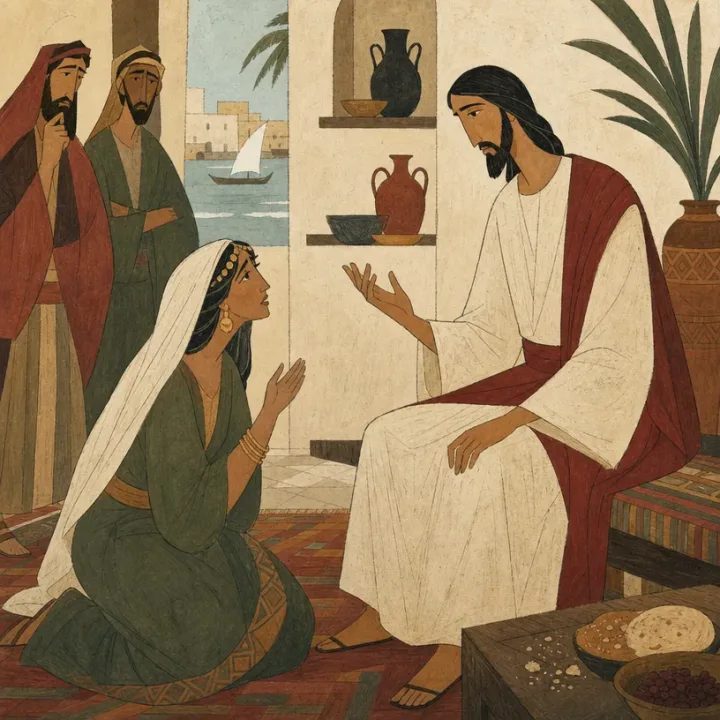
- Mark 7Jesus entered a house in the region of Tyre, where a Syrophoenician woman found him despite his wish not to be noticed.
- Luke 10Tyre was named as a place that would have repented had it seen the miracles.
Sources