
person
Job
אִיּוֹבἸώβ
Job, a blameless and upright man from Uz, endured severe trials and maintained his faith in God.
- verses
- 53
- first named
- Job 1:1
- last named
- Ezekiel 14:20
- period
- the Patriarchs
- role
- Man
Description
Who was Job?
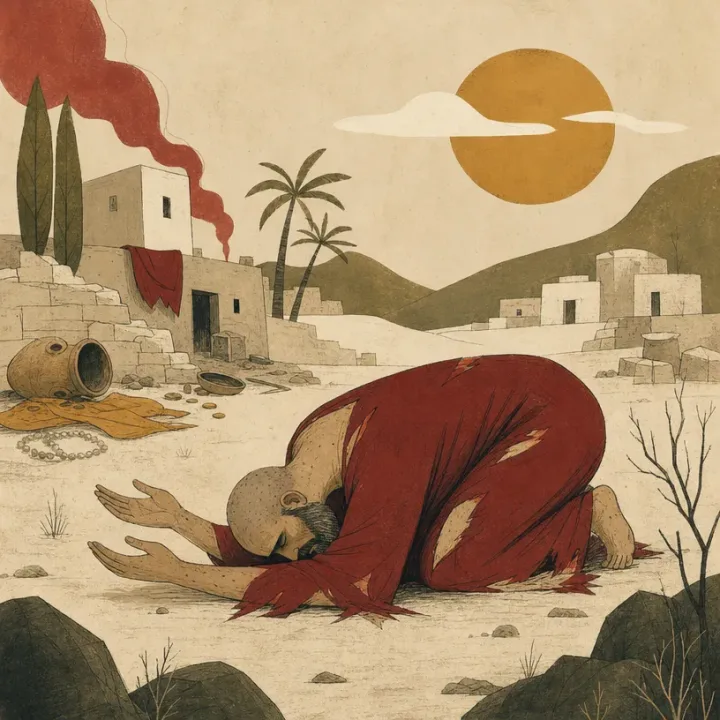
Job was a man from the land of Uz, described as blameless, upright, and one who feared God and shunned evil (Job.1.1). He was blessed with seven sons, three daughters, and great wealth (Job.1.2-3). However, God allowed Satan to test Job's faith through a series of severe trials, including the loss of his children, wealth, and health (Job.1.6-2.10).
Throughout his suffering, Job maintained his integrity and did not sin against God (Job.1.22; 2.10). He engaged in a lengthy dialogue with his three friends - Eliphaz, Bildad, and Zophar - who came to comfort him but ultimately accused him of wrongdoing (Job.2.11-31.40). A fourth friend, Elihu, also spoke to Job, emphasizing God's justice and sovereignty (Job.32-37).
Finally, God spoke to Job, challenging him to understand the mysteries of creation and divine wisdom (Job.38-41). Job acknowledged God's power and repented of his questioning (Job.42.1-6). In the end, God restored Job's fortunes, giving him twice as much as he had before, and blessed him with seven more sons and three more daughters (Job.42.10-17).
Job's story is a testament to faith in the face of adversity, and he is mentioned alongside Noah and Daniel as an example of righteousness (Ezk.14.14,20). His perseverance is also commended in the New Testament (Jas.5.11). The book of Job grapples with the question of suffering and the sovereignty of God, ultimately showcasing God's wisdom and the importance of trust in Him.
Relations
Direct connections
Every entity the graph places in a stated relation with this one, grouped by the kind of link. Each relation is authored once and its inverse derived, so both ends always agree. Rows marked “registry” come from the identity spine rather than from a verse, and a row marked “which bearer is the source’s decision” is one where the name could have meant more than one person. The last group is not a relation at all — it counts the events two entities stand in together.
The 10 best-attested of 15 are drawn. All 15 are listed below.
Father of
- Jemimahregistry, no verse
- Keren-happuchregistry, no verse
- Keziahregistry, no verse
Stands in the same events as
- LORD46 events
- Elihu10 events
- Righteousness4 events
- Three Men4 events
- Daniel3 events
- Noah3 events
- Enemy2 events
- Darkness2 events
- Justice2 events
- Stranger2 events
- Man1 event
- Person1 event
and 42 more, ordered by how many events they share.
Places
Where this happens
A person is placed by the events they take part in, and an event has to clear three things to place them: it must say where it happened, that place must be one the gazetteer can put a coordinate on, and the verse must report it rather than foretell, command or ask it. Nothing anchored here clears all three. Where the text names a setting no gazetteer surveys — a vineyard, a palace, a plot of ground — it is left off rather than guessed at; where a place is named only in a prophecy, the map does not draw what was said to be coming as though it had happened; and a place reached only through a relation is not inherited, because standing beside somebody is not being somewhere.
No verse Atlas has read as a report puts this person anywhere.
Not read yet
The pattern
Where Job is named
Every book of the corpus in the order it is read, each as wide as the chapters it holds. A bar is the verses of that book which write the name, and the flat stretches are as much of the answer as the bars.
53 verses across 3 of 66 books; 63 write the name nowhere. Named in Job (50), Ezekiel (2) and James (1).
Read it
Where to read it
Every verse of the text carried here that names this entity — 53, across 3 books. The name is written 57 times in them.
Onward
Where this page goes
Nothing in the graph stands one hop from this entity yet. These are the best-connected entities of the same type, so the page still ends somewhere. Descriptions by STEPBible TIPNR.
Where they appear
Chapter by chapter
Atlas's reading of each chapter this person appears in, in canonical order. One line per chapter, and each leads to the whole of it.
- Job 1Job offered burnt offerings for his children, then worshiped when his household and possessions were taken from him.
- Job 2Job scrapes his boils with broken pottery among the ashes, answers his wife, and sits in silence with his friends.
- Job 3Job opened his mouth and cursed the day of his birth, longing for darkness, rest and an end to his trouble.
- Job 6Job weighed his grief, challenged his friends, and asked to be shown his error.
- Job 9Job weighs the power and justice of God, searches for an answer, and ends by saying that he is on his own.
- Job 11Job was addressed as a speaker who claimed sound doctrine and purity, and as the man offered a conditional promise of restoration.
- Job 12Job answered his friends, defended his own understanding, and summoned animals, birds, earth, and fish as witnesses to God’s work.
- Job 16Job answers his comforters, describes himself as God's target, and appeals to a witness and advocate in heaven.
18 more chapters, from Job 19 to Ezekiel 14
- Job 19Job answers his reproachers, describes his ruin and abandonment, calls for pity, declares that his Redeemer lives, and warns his persecutors about the sword.
- Job 21Job challenged the tidy fate assigned to the wicked, setting their prosperity and peaceful deaths against the equal dust awaiting both the fortunate and the bitter.
- Job 23Job searched for God in every direction, prepared his case, kept to the path he claimed, and spoke on through the darkness.
- Job 26Job answered with pointed praise, then described the heavens, the sea, and the earth hanging upon nothing before calling it all only a faint whisper.
- Job 27Job maintained his integrity, challenged empty talk, and described the portion of the wicked.
- Job 29Job remembered the days when God watched over him, rescued the vulnerable, commanded a city gate’s attention, and comforted mourners as a king among his troops.
- Job 31Job binds his conduct under oath, challenges his accuser to write an indictment, and offers to wear it like a crown.
- Job 32Job was left unanswered by his three friends, who condemned him without refuting his arguments.
- Job 33Job had said that he was pure yet treated by God as an enemy, with his feet in the stocks and every path watched.
- Job 34Job declared himself righteous yet deprived of justice, and Elihu said that he clapped his hands and multiplied his words against God.
- Job 35Job was addressed by Elihu, who said that he opened his mouth in vain and multiplied words without knowledge.
- Job 36Job was addressed by Elihu as one who had been drawn from distress into a spacious place and then seized by judgment.
- Job 37Job is told to stand still, consider the wonders of God, and answer questions about clouds, lightning, and the skies.
- Job 38Job is questioned about the foundations of the earth, the paths of light, the weather, the stars, and food for ravens.
- Job 39Job is met with a long procession of questions about animals that give birth, roam, fight, fly, and feed beyond his command.
- Job 40Job answered the LORD, put his hand over his mouth, and said he had nothing to add.
- Job 42Job replied to the LORD, repented in dust and ashes, prayed for his friends, received restored prosperity, and died old and full of years.
- Ezekiel 14Job is named among three whose righteousness could reach no farther than themselves.
Sources